Is Your “Dominant Side” Really Dominant? What Body Asymmetry May Reveal About Stress and Protection
What if some of the imbalance we learn to accept as normal isn’t simply “how we’re built” — but reflects how the body has learned to organize itself?
Most of us have heard some version of this:
“My right side is my dominant side.”
“My left hip has always been tighter.”
“One shoulder just sits higher.”
“That leg is stronger.”
“That’s just how my body is.”
And sometimes, that explanation is completely reasonable.
Human beings are not perfectly symmetrical. We write with one hand. We kick with one leg. We develop movement preferences. Sports, occupations, injuries, anatomy and years of repetition can all create genuine differences from one side of the body to the other.
But after years of working directly with people and observing their bodies before and after Alphabiotic Alignment, I began asking a different question:
What if some of what we call our “dominant side” isn’t simply dominance?
What if, in some people, part of the difference we see or feel from one side to the other reflects an accustomed protective pattern — a way the nervous system has learned to organize the body over time?
That distinction matters.
Because if the pattern can change when the state of the nervous system changes, we may be looking at something more dynamic than we realized.
The Body Is Not Supposed to Be Perfectly Symmetrical
Before going further, this needs to be clear.
This is not an argument that every difference between the left and right sides of the body is caused by stress.
Normal laterality exists.
A tennis player’s serving arm may develop differently from the other arm. A soccer player may favor one leg. Years of repetitive work can produce genuine muscular differences. Structural anatomy varies. Previous injuries matter.
There are many possible reasons for asymmetry.
The question I am interested in is narrower:
Could some persistent asymmetry also reflect the way the nervous system is currently organizing and protecting the body?
My interest in that question didn’t begin with a theory.
It came from repeatedly observing what happened on the table.
What I Have Observed Across Several Thousand Alphabiotic Alignments
Over roughly eight years of practicing Alphabiotics and several thousand Alphabiotic Alignment sessions, I have repeatedly observed something that continues to interest me.
Before an alignment, I may assess how each leg responds to resistance.
Frequently, the two sides do not appear to respond equally.
One side may seem noticeably stronger or more organized than the other.
I may also observe an apparent difference in hip level or the way the body is resting and organizing itself on the table.
Then the person receives an Alphabiotic Alignment.
Immediately afterward, I reassess.
And many times, what appeared distinctly uneven beforehand presents as more balanced or more symmetrical afterward.
This is a practitioner observation.
It is not a diagnosis.
It does not establish that nervous-system stress caused the original asymmetry, and it does not mean every difference between two sides of the body will respond this way.
But the repeatability of the observation has made the underlying question difficult for me to ignore:
If an apparent imbalance can change within moments, what exactly were we observing before the change?
Structure — or State?
This is where the distinction becomes interesting.
Imagine someone has spent years being told:
“Your right leg is just stronger.”
“Your pelvis is uneven.”
“You’re left-side dominant.”
“That’s simply your body.”
But then something changes in the person’s nervous-system state, and immediately afterward the difference appears smaller.
The person’s bones did not suddenly grow.
Years of muscular development did not reverse in thirty seconds.
Their anatomy did not fundamentally change.
So at least in those instances, it raises the possibility that state may have been contributing to what looked like structure.
That doesn’t mean structure is irrelevant.
It means structure may not always tell the whole story.
The Nervous System Organizes the Body
We often talk about muscles as though they operate independently.
A hamstring is “tight.”
A hip is “weak.”
A shoulder is “restricted.”
So we stretch the tight thing.
Strengthen the weak thing.
Massage the painful thing.
Mobilize the restricted thing.
Sometimes that is exactly what is useful.
But muscles don’t make decisions independently.
Movement, muscle tone, balance, coordination and protective responses are all influenced by the nervous system.
When the system perceives threat — whether that threat is immediate or whether protective responses have simply become habitual — the body can organize accordingly.
Muscles may brace.
Movement may change.
Breathing may change.
Weight distribution may change.
Certain areas may become guarded.
The entire organism adapts.
What is fascinating is that adaptation can eventually feel normal.
When Protection Becomes Familiar
Imagine holding your shoulders slightly elevated every day.
At first, you would notice it.
Eventually, you might not.
Imagine subtly shifting weight toward one leg thousands of times.
Imagine repeatedly bracing one hip.
Imagine rotating slightly through the torso.
Imagine years of stress, injuries, habitual movement and compensation interacting with one another.
Eventually, the pattern may stop feeling like a pattern.
It may simply feel like you.
And this is where language such as “my bad side,” “my tight side” or even “my dominant side” becomes interesting.
We may be describing what we consistently experience without necessarily knowing why the body is presenting that way.
Three Different Things Can Look Similar
It is useful to distinguish at least three possibilities.
Natural laterality is the ordinary left-right preference present in human beings.
Developed dominance can result from sport, occupation, training and repeated movement.
And then there may be protective asymmetry — a potentially more changeable pattern associated with how the body is currently organizing itself.
These possibilities can coexist.
A right-handed person can genuinely be right-side dominant while also carrying an additional protective pattern.
This is not about replacing one simplistic explanation with another.
It is about widening the question.
What Happens If We Reset Before We Correct?
This is where the idea becomes practical.
If somebody presents with one tight hip, one stronger leg or an elevated shoulder, the natural response is often to begin correcting the asymmetry.
Stretch it.
Strengthen it.
Mobilize it.
Massage it.
Adjust it.
Work harder on the weaker side.
But there may be another question worth asking first:
What happens if we address the state from which the body is organizing before trying to correct the organization itself?
In other words:
That does not mean abandoning exercise, physical therapy, chiropractic, massage, yoga, mobility work or other useful approaches.
It means asking whether those interventions may sometimes interact differently with a body that is presenting from a different nervous-system state.
Protection / Asymmetry → Reset → Greater Apparent Symmetry
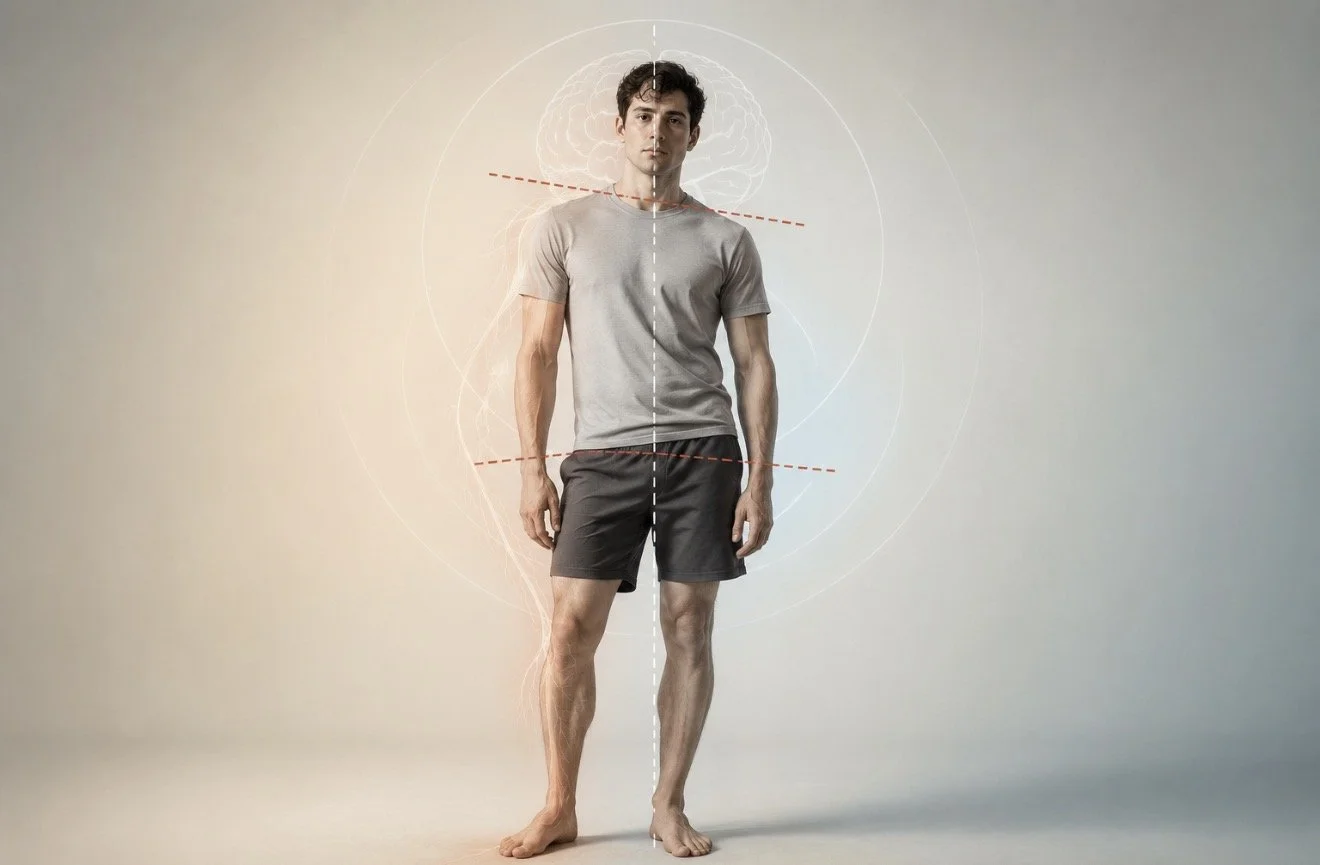
A simple visual can show three stages:
Protection / Asymmetry → Nervous-System Reset → Greater Apparent Symmetry
The first figure can show a subtle elevated hip or shoulder and uneven weight distribution.
The middle figure represents the transition or reset.
The final figure appears more centered and even — without suggesting artificial or perfect symmetry.
The point is not to depict a medical correction.
It is to illustrate a possible change in organization.
A Different Way to Think About the “Dominant Side”
This brings us back to the original question.
What if we have culturally normalized certain asymmetries because they are so common?
Again, some are normal.
Some are structural.
Some are trained.
Some follow injury.
But perhaps some are also the visible expression of an organism that has spent a long time adapting.
If so, calling everything a “dominant side” could occasionally cause us to stop investigating too early.
The label describes the pattern.
It doesn’t necessarily explain it.
Why This Matters Beyond Posture
This conversation is bigger than whether one hip sits slightly higher than another.
The same broader principle can be considered throughout the body.
We often focus on the location where something appears.
Tight neck.
Restricted shoulder.
Back tension.
Uneven hips.
Difficulty relaxing.
Changes in recovery.
And we naturally try to change the thing we can see or feel.
But sometimes a broader question is worth asking:
What is the whole system doing?
The human body is not a collection of independent pieces.
It is an interconnected organism continuously receiving information, responding to its environment and adapting.
That is why nervous-system state has become an important lens through which I view my work.
What Alphabiotic Alignment Adds to This Conversation
Alphabiotic Alignment is a brief, non-invasive process performed above the spine.
In my practice, I use it as an experience intended to provide a distinct sensory input and an opportunity to observe how a person’s organization may present before and afterward.
The alignment itself is brief.
What interests me is what can sometimes be observed around it.
Breathing may appear different.
Muscular holding may appear different.
The person’s subjective experience may be different.
And, as described earlier, apparent side-to-side differences that were obvious immediately beforehand may sometimes present differently immediately afterward.
I do not consider that proof of a particular physiological mechanism.
I consider it a practitioner observation worth paying attention to.
Because when something appears capable of changing rapidly, it raises an interesting question about how fixed — or how adaptable — the original presentation may have been.
Before You Chase the Imbalance, Ask a Better Question
If one side of your body feels different from the other, there may be many reasons.
Structural differences, training history, previous injuries, movement habits and other factors can all contribute.
Persistent pain, weakness, neurological changes or other health concerns should be evaluated by an appropriately qualified healthcare professional.
But there is another layer worth considering.
Before assuming that every asymmetry needs to be mechanically corrected, consider asking:
What happens to this pattern when the nervous system experiences a different state?
Does the body still organize itself the same way?
Does the difference appear identical?
Does movement feel different?
Does the person experience themselves differently?
Those observations may give us additional information.
Maybe “Normal for Me” Isn’t Always the End of the Story
Human beings are extraordinarily adaptive.
That is one of our greatest strengths.
But adaptation has an interesting consequence:
We can become accustomed to patterns.
A pattern can become familiar.
Familiar can become normal.
And eventually, normal can become identity.
“My bad hip.”
“My weak leg.”
“My dominant side.”
“My tight shoulder.”
Sometimes those descriptions may reflect enduring anatomical, developmental or trained differences.
And sometimes, perhaps, they describe an adaptation that has been present for so long that we rarely question it anymore.
So perhaps the question isn’t only:
Which side is dominant?
Perhaps sometimes the more interesting question is:
What has the body been adapting to?
About the Practicioner
Dillon Ayer is a Board-Certified Developmental Alphabioticist with eight years of focused practice and more than 13 years of professional hands-on experience in licensed and clinical environments.
Continue Exploring
Why Does One Side of Your Body Feel Different Than the Other?
Explore the relationship between body asymmetry, muscle imbalance, tight hips and protective patterns.
Are You Treating the Pain — or Asking Why the Body Is Still Protecting?
A deeper look at the difference between addressing where tension appears and asking why protection may still be present.
Scoliosis, Protection Patterns, and the Nervous System
Explore another perspective on structure, adaptation and nervous-system state.
Nervous System Reset in Delray Beach
Read the main BrainReboot.org guide to the nervous-system framework behind this work.
Educational Note
This article shares practitioner observations and an educational perspective on nervous-system state, protection patterns and body asymmetry. It is not intended to diagnose, treat, cure or prevent any medical condition and should not be interpreted as medical advice.
Body asymmetry can have many causes. Persistent pain, weakness, neurological changes or other health concerns should be evaluated by an appropriately qualified healthcare professional.