Bad posture. Rounded shoulders. Forward head posture. Tight hips. Uneven hips. A hip hike. One shoulder higher than the other. Feeling crooked when you stand.
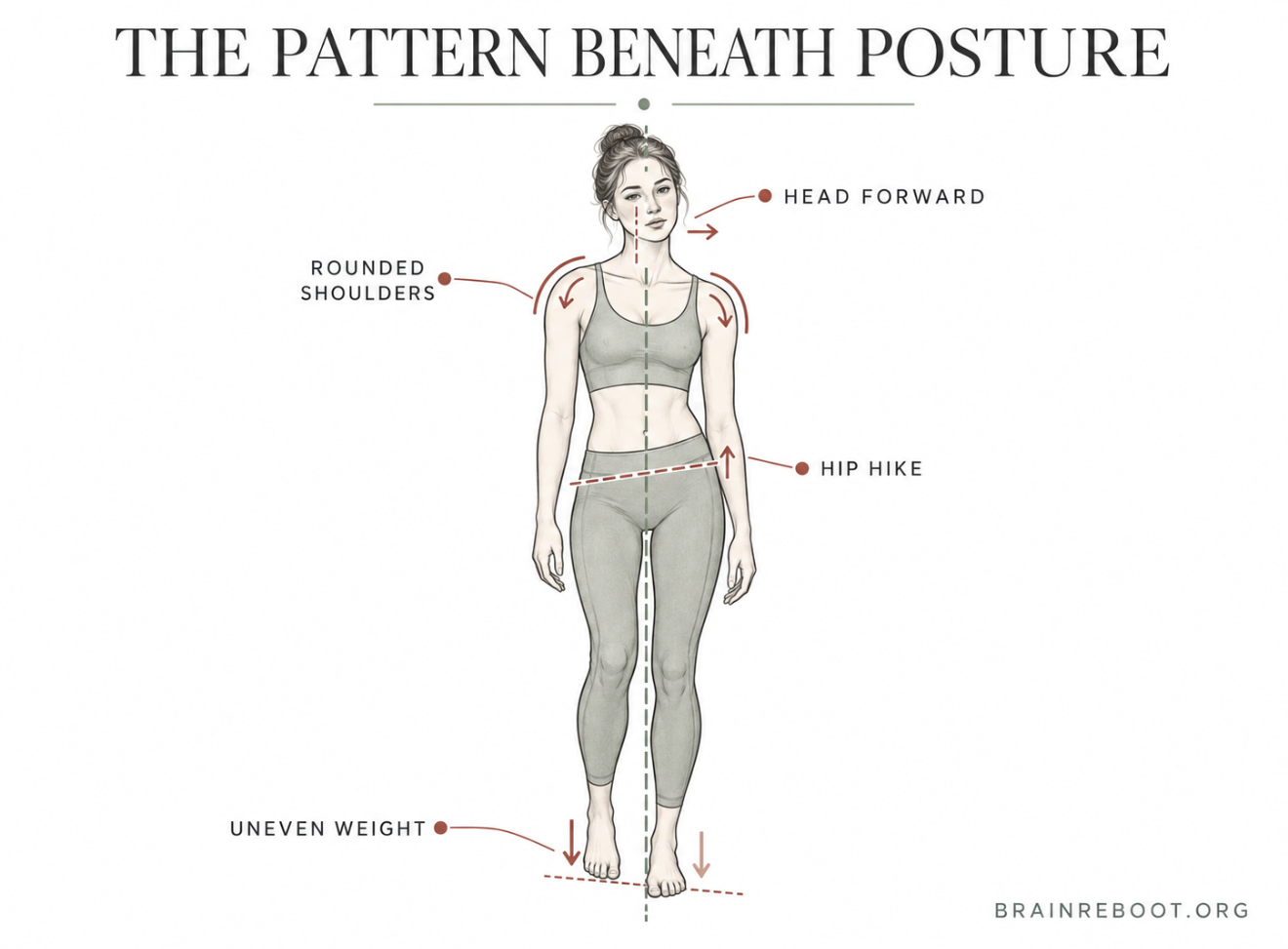
If you recognize yourself somewhere on that list, there’s a good chance you’ve tried to fix your posture.
Maybe you stretch. Maybe you strengthen your core. Maybe you practice yoga. Maybe you consciously pull your shoulders back. Maybe you’re constantly trying to release tight hips, correct a hip hike or figure out why one side of your body feels different from the other.
Maybe somebody has been telling you for years:
“Stand up straight.”
There can absolutely be value in strength, mobility, movement, yoga, bodywork and postural awareness.
But after eight years practicing Alphabiotic Alignment — and several thousand alignments — I’ve become fascinated by a different question:
What if your body already knows how to stand taller?
What if the body isn’t necessarily waiting for another instruction about where to put the shoulders, hips or head?
What if it’s trying to come back into growth?
Why Are We Always Trying to Fix Our Posture?
The conversation around posture is usually about correction. How do I fix bad posture? How do I correct rounded shoulders. Why are my hips uneven? How do I fix a hip hike? Why are my hips so tight? How do I improve forward head posture? What exercises will make me stand straighter?
These are understandable questions. But there is an assumption underneath many of them:
The body is in the wrong position, so we need to manually put it into the right position.
I think there’s another question worth asking.
Why did the body organize itself that way in the first place?
That same question comes up when the body keeps holding stress.
That question takes us beyond posture alone and into the nervous system.
Protection and Growth
In Alphabiotics, we are trained to understand the human organism through the principles of protection and growth.
When the primitive brain perceives threat, the stress response engages and the organism prioritizes protection. Within this framework, we discuss the HPA axis and the changes that can accompany a system organizing itself around perceived threat.
Protection isn’t stupidity. Protection isn’t failure. Protection is intelligence.
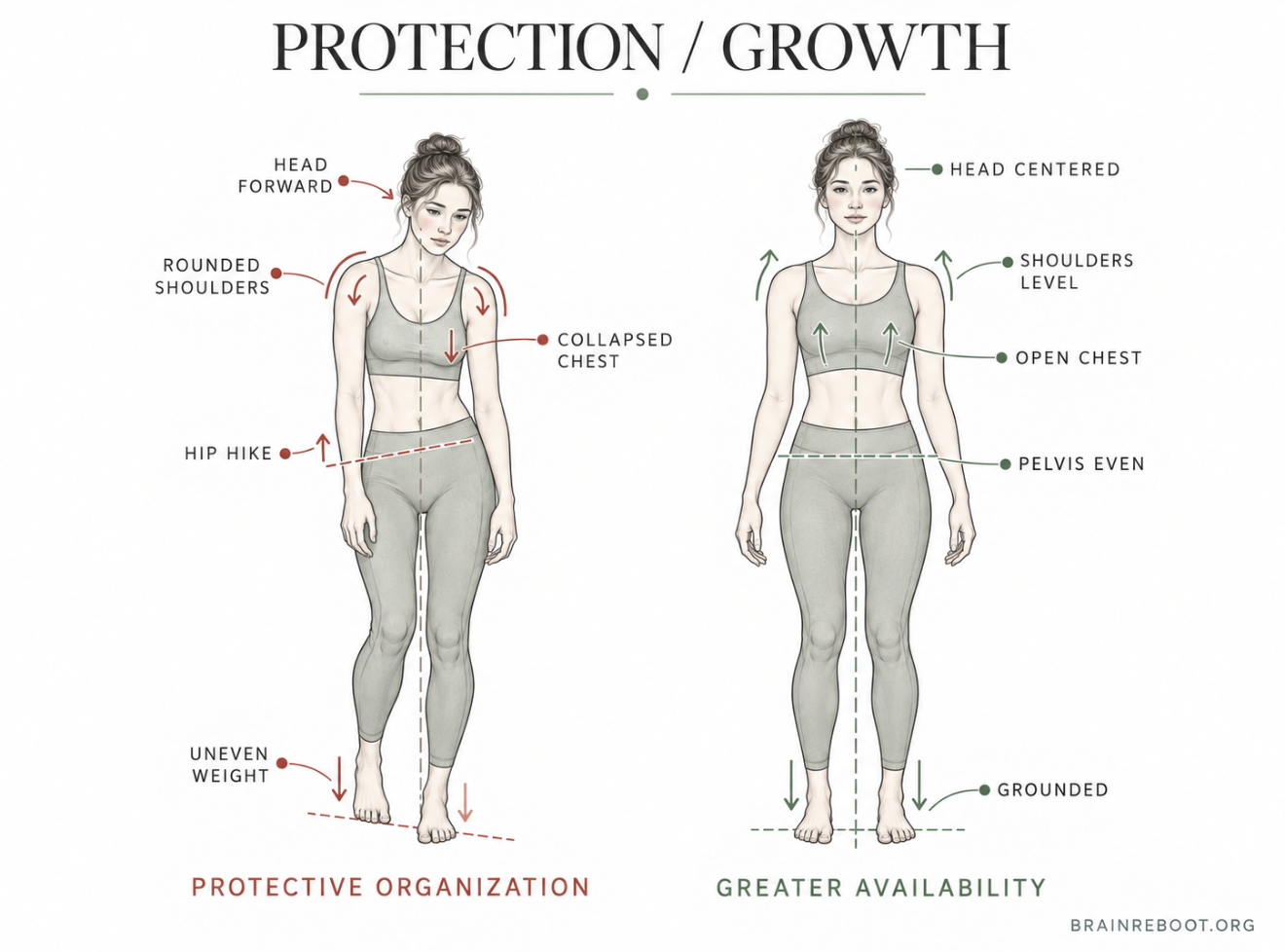
The organism is doing something for a reason. And protection has a shape. We contract. We become smaller.
The head can move forward. The shoulders can come inward. The torso can become less expansive. The hips can tighten. The body may shift asymmetrically, with one side appearing more dominant or one hip appearing higher than the other.
Within the Alphabiotic framework, these patterns can be viewed through the lens of an organism organizing itself for protection.
Now picture growth. The body no longer needs to make itself as small. It can rise. It can open. It can occupy more space.
And this is where something I have heard countless times after an alignment becomes particularly interesting.
“Whoa. I Feel Taller.”
I hear this all the time.
Someone gets off the alignment table, stands for a moment and says:
“Whoa. I feel taller.”Sometimes they ask: “Did you stretch me?” No.
I didn’t stretch you. I didn’t spend an hour lengthening the body. I didn’t pull the shoulders backward. I didn’t manipulate the hips into what I decided was the correct position. I didn’t tell the person to stand straighter.
I administered the Alphabiotic Alignment - what I often describe in simple language as pressing the reset button - and then their own system responded.
That distinction is central to this work.
I’m Not Correcting Your Posture
This is where Alphabiotic Alignment can be misunderstood. If somebody gets off the table standing taller, it would be easy to say: “You corrected their posture.” But that isn’t how I see what happened.
I didn’t correct their posture.
If I physically place your shoulders where I think they belong, I’m imposing a position from the outside.
If I tell you to stand straighter, you’re consciously maintaining a position.
If I stretch a tight area, I’m mechanically working with that area.
Alphabiotic Alignment is different.
I administer the alignment.
In the language of the work, I’m giving the nervous system a reset signal.
Then I get out of the way.
The organism does the reorganizing.
That’s why the spontaneous statement “I feel taller” has remained so interesting to me over thousands of alignments.
I didn’t ask for it.
They aren’t performing it.
They notice it.
Yesterday, It Happened Again
Yesterday I aligned someone who happens to be a dietitian. When she stood up afterward, she immediately noticed the way she was experiencing her body. She felt taller. Then she used another word: Growth.
She described feeling as though she had come back into a state of growth. That caught my attention.
Because she was describing, in her own language, something remarkably close to the protection-and-growth principles at the foundation of the work.
I hadn’t told her to stand differently.
I hadn’t corrected her posture.
I hadn’t stretched her taller.
I administered the alignment.
She stood up herself.
And what she experienced was growth.
“I Know Why This Hip Is Higher.”
There is another conversation I have heard countless times during my years practicing Alphabiotic Alignment - and even earlier through my work in bodywork and massage.
People want to know why their body is the way it is. Especially when they notice an asymmetry.
One hip is higher. One leg seems shorter. One shoulder sits differently. One side always feels tighter. And almost immediately, we start looking for the story.
“I fell when I was a kid.”
“I always carried my baby on this hip.”
“It’s probably because of the way I drive.”
“I always stand on this leg.”
“I’ve always been tighter on that side.”
I’ve heard variations of these explanations countless times.
And sometimes there may be very real mechanical, structural or historical factors involved. An old injury matters. Repetitive movement matters. How we use our bodies is important.
I’ve become interested in our almost automatic need to assign every asymmetry a mechanical story.
Because there may be another layer to consider.
What if the body isn’t simply crooked?
What if some of what we’re observing is the body adapting?
What If a Hip Hike Isn’t Just Something to Fight?
Take a hip hike. Someone sees that one hip appears higher than the other and understandably thinks:
I need to correct that. Stretch the tight side. Strengthen the weak side. Push this hip down. Bring that side up. Make the pelvis level.
Again, there are situations where assessment by an appropriately qualified healthcare or movement professional is important, particularly when pain, injury or significant functional problems are present.
But from the protection-and-growth perspective, another question belongs in the room:
What if at least part of what you’re seeing is an adaptive pattern rather than simply a mistake?
Within the Alphabiotic model, protection can involve asymmetrical organization of the body - one side becoming more dominant as the organism prepares itself to respond.
So rather than immediately declaring:
“This Pelvis/Hips are off.”
I’m interested in asking:
“What is the organism doing?”
That’s a fundamentally different relationship with the body.
Your Body Isn’t Stupid
This may be the most important point in this entire conversation.
Your body Isn’t Stupid. Yet look at the language we often use around posture. Bad posture. Wrong posture. Misaligned. Crooked. Fix it. Correct it. Stretch it. Force it back into place.
We can end up treating an extraordinarily adaptive organism as though it simply forgot where to put its own parts.
But what if the body is responding intelligently to the information it is receiving?
What if the posture we dislike is, at least in part, an expression of adaptation?
Then constantly fighting the physical expression without considering the state underneath it becomes a very different proposition.
We’re telling the body:
“Stop doing that.”
While the organism may believe it has a reason for doing exactly that.
Are You Correcting Your Posture - or Overriding It?
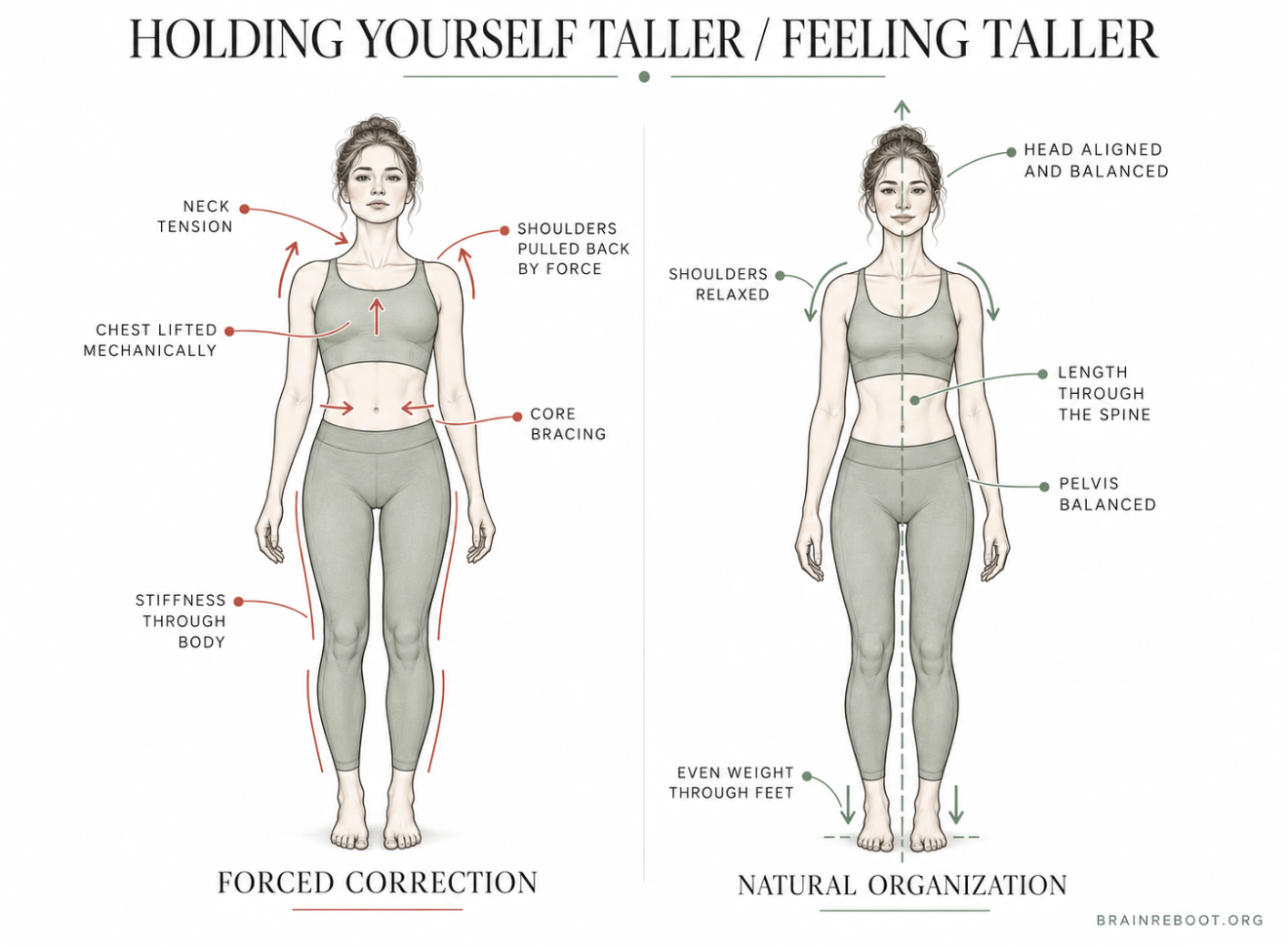
Try something. Pull your shoulders backward. Lift your chest. Straighten your head. Stand as tall as possible. You can probably change your posture immediately. But now stop thinking about it.
What happens ten minutes later?
If your body returns to its previous organization, what did you actually change? You successfully held a different posture.
That’s not necessarily the same thing as your body naturally finding a different posture.
This is why I think there is an important distinction between:
Holding yourself taller
and
feeling taller.
One is an instruction.
The other is an experience.
Growth Doesn’t Look Forced
Imagine somebody standing in what we might call a growth state. I don’t picture military posture. I don’t picture somebody aggressively pulling their shoulders backward or sticking their chest out. I picture something much simpler. A human being naturally occupying their space. Upright without forcing upright. Open without trying to look open. Tall without trying to look tall.
There is less contraction. Less need to make the body small. And this is what fascinates me when somebody gets off the alignment table and spontaneously looks or feels different.
They weren’t given a posture lesson.
They aren’t remembering an exercise.
Nobody said:
“Stand up straight.”
They simply stood up.
The Correcting-Posture Paradox
This leads to what I think is one of the most interesting questions in the entire posture conversation.
Could constantly trying to manually correct our posture sometimes mean we’re fighting the intelligence of the body rather than listening to it?
Not always.
And this isn’t an argument against exercise, physical therapy, yoga, massage, mobility work, strength training or appropriate medical care.
It’s an invitation to add another layer.
Because if the organism is organizing around protection, perhaps the answer isn’t always another command about where the shoulder or hip should go.
Maybe the state deserves our attention too.
So What Am I Actually Doing During an Alignment?
People sometimes assume that because they stand differently afterward, I must have physically corrected something.
That’s not what happened.
I’m not trying to decide where your hips belong.
I’m not trying to manually straighten you.
I’m not forcing your body toward symmetry.
I’m administering the alignment.
In the Alphabiotic framework, the alignment provides the nervous system with a reset signal - an opportunity to interrupt the habitual protection pattern and return toward growth.
Then your own organism responds.
That’s why I use the phrase pressing the reset button.
The button doesn’t manually rearrange every part of you.
The reset changes the information.
Your system does the rest.
Maybe Your Body Already Knows
So if you arrived here because you’ve been searching for: “How do I fix my posture?” “How do I correct bad posture?”
“Why are my hips uneven?” “How do I fix a hip hike?” “Why do I have tight hips?” “How do I fix rounded shoulders?”
“How do I stand straighter?” Keep exploring those questions.
But add another one.
What state is my nervous system asking my body to organize around?
Because perhaps your body doesn’t need to be endlessly commanded into growth.
Perhaps growth is already where the organism wants to go.
Protection serves an important purpose.
But when the perceived need for protection changes, what happens to the body?
That’s the question that continues to fascinate me.
After eight years practicing Alphabiotic Alignment and several thousand alignments, I’ve watched the same simple moment happen again and again.
Someone gets off the table.
They stand.
They notice themselves.
And then:
“Whoa. I feel taller.”
I didn’t stretch them taller.
I didn’t manually correct their posture.
I didn’t tell them where to put their hips or shoulders.
I administered the alignment.
Their own system responded.
Maybe the body isn’t always waiting for us to correct it.
Maybe it’s already trying to come back into growth.
Alphabiotic Alignment · Delray Beach, Florida
Continue Exploring
Nervous System Reset in Delray Beach: Why the Body Holds Stress, and How It Releases It
Reset First: Why Nervous System State Matters Before the Next Input
Nervous System Reset — Delray Beach
About the Practitioner
Dillon Ayer is a Board-Certified Developmental Alphabioticist and Licensed Massage Therapist based in Delray Beach, Florida. He has practiced Alphabiotic Alignment for eight years and has administered several thousand alignments.
His work through BrainReboot.org explores the relationship between nervous-system state, protection and growth, and the body’s innate capacity to reorganize when given an opportunity to reset.
Learn more about Alphabiotic Alignment and BrainReboot.org.
This article shares the protection-and-growth framework taught within Alphabiotics together with practitioner observations from my work as a Developmental Alphabioticist. It is educational in nature. Alphabiotic Alignment is a non-medical practice and is not presented as diagnosing or treating musculoskeletal, neurological or other medical conditions. Persistent pain, significant asymmetry or other health concerns should be evaluated by an appropriately qualified healthcare professional.