You pull into the driveway, put the car in park and turn off the engine. Then you notice how hard you're still gripping the wheel. The interesting part is the second before you noticed. That much effort felt normal.
The drive is over. The traffic is over. The meeting, the argument, the deadline — over.
So why are your hands still holding on?
And if your hands are still holding on, what else is?
The Short Answer
Tightening up is one of the body's most basic responses to stress. The American Psychological Association describes muscle tension as almost a reflex reaction to stress — the body's way of guarding against injury and pain.
With a sudden stress, the muscles tense all at once and release again when the stress passes. That's the system working the way it's meant to.
With ongoing stress, the APA explains, the muscles can stay in a more or less constant state of guardedness.
That's the part most of us know without ever reading it. The stressful thing ends. The guarding doesn't always end with it.
The shoulders stay up. The jaw stays set. The breath stays a little high in the chest. And because it's been there a while, it stops feeling like tension at all.
It just feels like you.
The Breaker Switch Principle
Think about the electrical panel in your house.
When a circuit is overloaded, the breaker trips. The power to that part of the house cuts out. That isn't a fault. That's the system protecting the house. It's doing exactly what it was designed to do.
Now unplug the space heater, the hair dryer and the kettle. The overload is gone.
Does the power come back on by itself?
No. The overload is over, but the breaker is still tripped. Something has to reset it.
I find that a useful way to talk about the body. Not as a diagram of what's happening inside you, but as a picture of a pattern I see every week:
The stress can be over while the protection is still switched on.
The body went into protection for a reason. Protection isn't a defect. Protection is intelligence. And the body has its own ways of resetting: sleep, time outdoors, a good laugh, a long exhale, people you feel safe with.
But sometimes the breaker stays tripped. A protective state that stays on long after the reason has passed starts to feel like normal life. Tight becomes normal. Braced becomes normal. Holding on becomes normal.
Resetting the breaker is what my work is about. Of everything I've trained in over 25 years, the Alphabiotic Alignment is the most direct way I've found to assist another person's system in resetting.
"That's Just How I Stand"
This is where people usually stop me.
"That's just how I stand."
"I've always been tighter on that side."
"That's my dominant side."
Maybe. Old injuries matter. How we use our bodies matters. But I've become very interested in how quickly we explain a pattern away, and how rarely we ask whether it might be the body organizing itself around protection. I've written more about that in Is Your "Dominant Side" Really Dominant?
Look at the two figures below. Same person. Same scale.
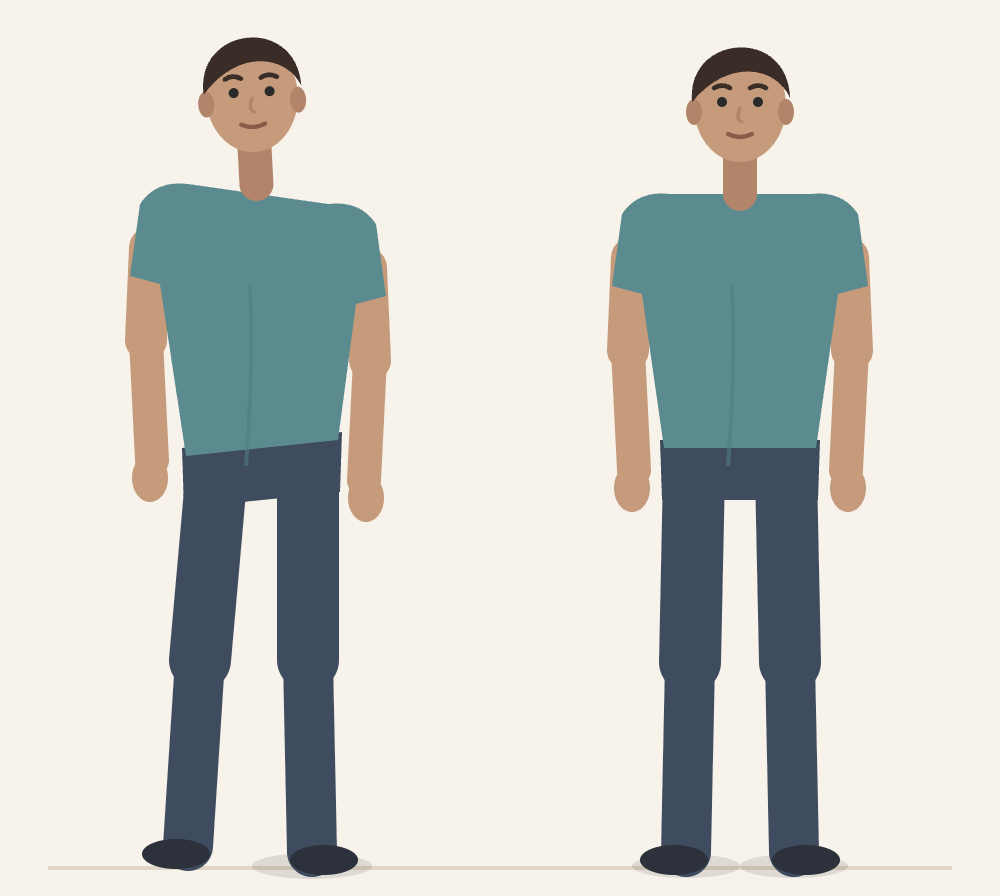
Nothing dramatic is happening on the left. No pain on the face, no obvious problem. One shoulder sits a little higher. A little more weight lives on one leg.
That's the point. Protection is often quiet. It's the grip on the steering wheel you didn't notice until the engine was off.
I'm not showing you this to say one stance is right and one is wrong, or to say what's going on inside anyone's body. A picture can't tell you that, and neither can I by looking at you. It's simply an invitation to notice.
What's at the Base of the Skull?
Alphabiotic Alignment is a unique, non-invasive, hands-on process just above the spine, at the base of the skull, so it's worth being accurate about that area.
Just below the back of the skull is the suboccipital region: a group of small, deep muscles connecting the top of the neck to the head. Many people know this spot already. It's where your fingers go at the end of a long day.
Deeper inside, well beyond anything a hand touches, is the brainstem. Its lowest part, the medulla, sits where the brain meets the spinal cord and is involved in automatic functions like breathing and heart rhythm.
When people talk about the stress response, you'll often hear about the HPA axis. HPA stands for hypothalamus, pituitary and adrenal — a hormone pathway linking the brain and the adrenal glands that's part of how the body responds to stress.
In Alphabiotics, we're trained to understand the organism through protection and growth, and that's the framework I work from. I don't measure hormone levels or anything happening in the brainstem. What I can share is what I do and what people notice.
What Actually Happens on the Table
Here's what a visit with me looks like.
You stay fully clothed. You lie on the alignment table with your head supported. Nothing is forced and nothing is twisted.
Before the alignment, I'll usually do a simple check of the strength in the arms and legs. I'm not using it to diagnose anything or to measure what's going on inside you. It's a before-and-after comparison, and you get to feel it for yourself.
Then I administer the Alphabiotic Alignment, a unique, non-invasive, hands-on process just above the spine, at the base of the skull. In plain language, I often describe it as pressing the reset button. If you're wondering what "reset" really means here, I go into it in Why the Body Holds Stress, and How It Releases It.
Then we check again.
And then the part I never rush.
You stand up.
I give that moment space. Feet on the floor. Weight finding its way into both legs. A breath. People look around the room as though they've just walked into it.
Some people say, "Whoa. I feel taller." Some ask, "Did you stretch me?" I didn't. I didn't move your shoulders anywhere or tell you how to stand.
The way I understand it, the body is always trying to come back into growth. When the protection eases, people stand up taller because that's where the organism wants to go. I press the reset button. The body does the rest.
And some people stand up and don't notice anything distinct at all. That's fine too. Not everyone notices something straight away, and I'd rather you tell me honestly than tell me what you think I want to hear.
The first visit in the office takes about 45 minutes, because a good part of it is explaining what we're doing and why. Returning visits are about 20 minutes.
Why It Shows Up This Time of Year
Here in South Florida it gets dark earlier now, and the calendar fills up. Traffic, travel, family, end-of-year deadlines. You can feel fine all day and then notice, sitting in the car after a family gathering, that your shoulders are somewhere up near your ears.
The same thing happens to riders. The jump-off is over, the horse is cooled out, and the body is still riding the course.
It doesn't need to be the holidays. July has its own version. The moment the effort stops is often the moment you finally notice how much effort there was.
Something to Notice Today
Next time you turn off the engine, before you open the door, stop for one breath.
Notice your hands. Your shoulders. Your jaw. Where your weight is in the seat.
Don't fix anything. Don't force anything to relax.
Just notice what felt normal a second ago.
That second is where this whole conversation starts.
Quick Answers
Why does my body stay tense after stress is over?
Muscle tension is one of the body's basic protective responses to stress. After a short stress the muscles usually release; with ongoing stress they can stay guarded, and that guarded state can start to feel normal.
What is Alphabiotic Alignment?
A unique, non-invasive, hands-on process just above the spine, at the base of the skull, while you lie fully clothed on a table. It's a non-medical practice focused on stress relief, reduction and recovery, and it doesn't replace care from your doctor.
Will I feel different afterward?
There's no set outcome. Some people notice they feel taller or lighter when they stand up; some don't notice anything distinct. Both are normal.
If you'd like to experience it for yourself, you can book a first visit in Delray Beach. If coming to the office isn't practical, I also offer in-home visits across Palm Beach County.
Alphabiotic Alignment · Delray Beach, Florida
Continue Exploring
Is Your "Dominant Side" Really Dominant?
Why the Body Holds Stress, and How It Releases It
Trying to Fix Your Posture? What If Your Body Is Already Trying to Correct It?
Why Alphabiotics Is So Hard to Explain Until You Experience It
Nervous System Reset — Delray Beach
About the Practitioner
Dillon Ayer is a Board-Certified Developmental Alphabioticist and Licensed Massage Therapist based in Delray Beach, Florida. He has practiced Alphabiotic Alignment for eight years and has administered several thousand alignments. He has also been a registered yoga teacher since 2010.
His work through BrainReboot.org explores the relationship between nervous-system state, protection and growth, and the body's innate capacity to reorganize when given an opportunity to reset.
Learn more about Alphabiotic Alignment and BrainReboot.org.
This article shares the protection-and-growth framework taught within Alphabiotics together with practitioner observations from my work as a Developmental Alphabioticist. It is educational in nature. Alphabiotic Alignment is a non-medical practice and is not presented as diagnosing or treating any medical condition. Persistent pain, tension or other health concerns should be evaluated by an appropriately qualified healthcare professional.
Source: American Psychological Association, "Stress effects on the body" (apa.org/topics/stress/body).